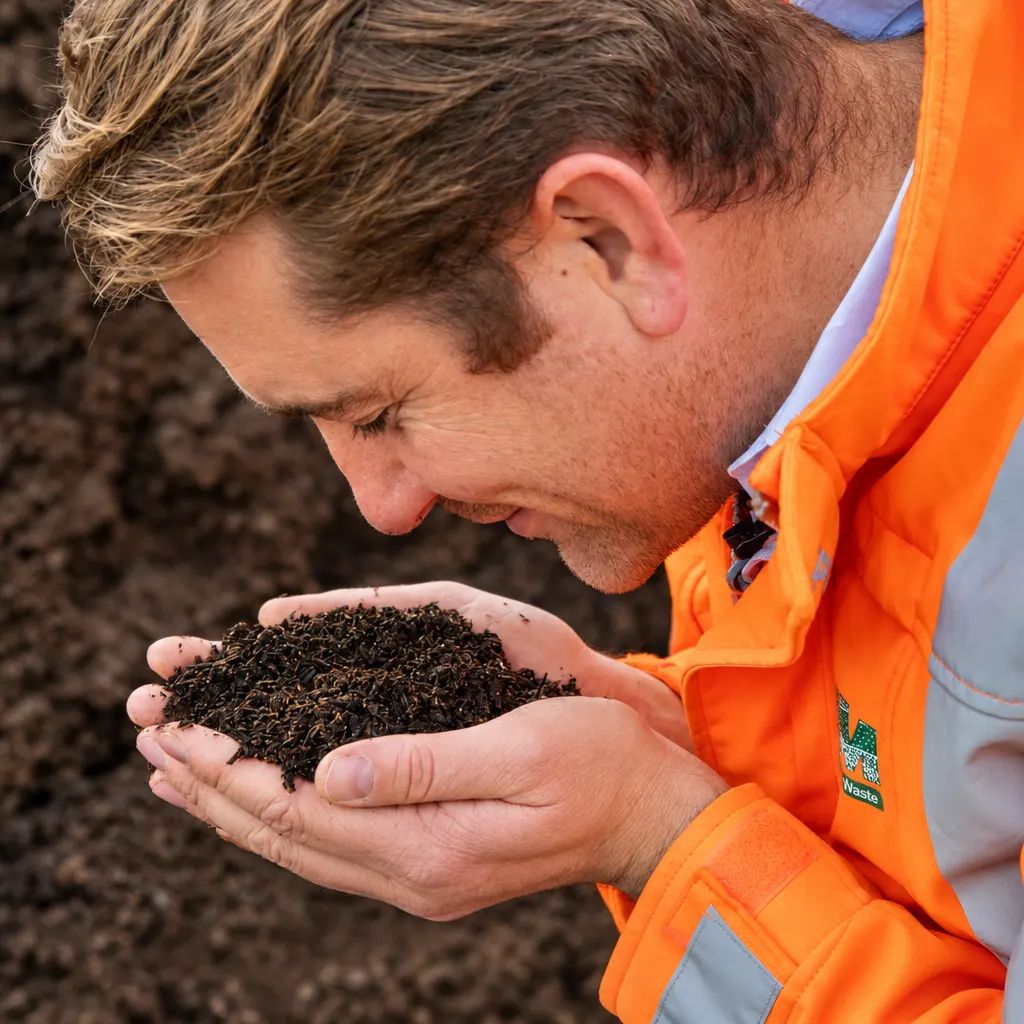
Topsoil: It’s just dirt, isn’t it?

We catch up with MCM’s Darrel Burgess to discover why there’s a lot more to topsoil than meets the eye.
There was a time when topsoil was simply dug out of one site and delivered to another, with very little thought about what was actually in it. These days, things are rather different. “People tend to think that topsoil is just dirt,” says Darrel Burgess, MCM’s Sales and Soil Development Director. “But there’s a lot more science involved than you might imagine.”
The importance of soil testing
Today, soil recovered from construction sites will often undergo testing for contaminants, including substances such as polycyclic aromatic hydrocarbons (PAHs), before decisions are made about how it can be handled, treated or reused.
“Quite often, we’ll get a call from a contractor who’s about to start excavating a site. They want to know what they can do with all the soil they’re digging out. We’ll arrange testing to establish what we’re dealing with and then see whether we can find a suitable use for it.”
Not all topsoil is created equal
And that’s where things start to get interesting.
Some projects require low-nutrient soils for wildflower meadows, while others need lightweight growing media for roof gardens. Depending on its properties, recovered soil can be taken to one of MCM’s batching facilities and blended with other materials to create something entirely different.
“One of my favourite examples was the Queen Elizabeth II Garden in Regent’s Park,” recalls Darrel. “We supplied concrete from Heathrow Airport, selected from three tested samples, that was used as one of the base ingredients for the low-nutrient growing medium for the wildflower meadows.”
It’s a rather wonderful thought that material recovered from one of the world’s busiest airports could end up helping wildflowers flourish in the middle of London. By incorporating recycled materials, the project also supported its wider sustainability objectives.
Essential to healthy plant growth
But there’s another side to topsoil that often gets overlooked. “People forget that soil is actually alive,” explains Darrel. “It’s full of organisms, bacteria and fungi that are essential to healthy plant growth. If you store it badly, particularly in large stockpiles for long periods, you can starve it of oxygen and seriously damage its biological health.” In other words, there’s a lot more to looking after topsoil than simply keeping it in a pile until somebody needs it. And sometimes the challenge isn’t finding a new use for soil, but dealing with soil that has become contaminated.“We had a call recently from a client who’d had a diesel spill on site. We were able to advise them on containing the spill and then arrange for rapid testing to determine the extent of contamination so that we could determine the most appropriate method of disposal. It wasn’t suitable for reuse as topsoil, but we were able to find an alternative to simply sending it to landfill.”It’s all part of a business that involves considerably more than moving materials from A to B. For Darrel, the important thing is recognising that topsoil is a valuable resource, not something to be thrown away without a second thought.
Got a soil problem? Have a chat with Darrel.
“Topsoil has taken millions of years to be created and is a finite resource. It seems crazy that we sometimes treat it as waste when, with the right knowledge and handling, it can be put to such good use.”
Whether you need specialist blended topsoil, advice on recovered materials or help with soil removal, Darrel and the team at MCM are always happy to talk.
Call MCM on 020 8339 9909.